
Recovery Tracking
Stop Holding Your Members' Week in Your Head
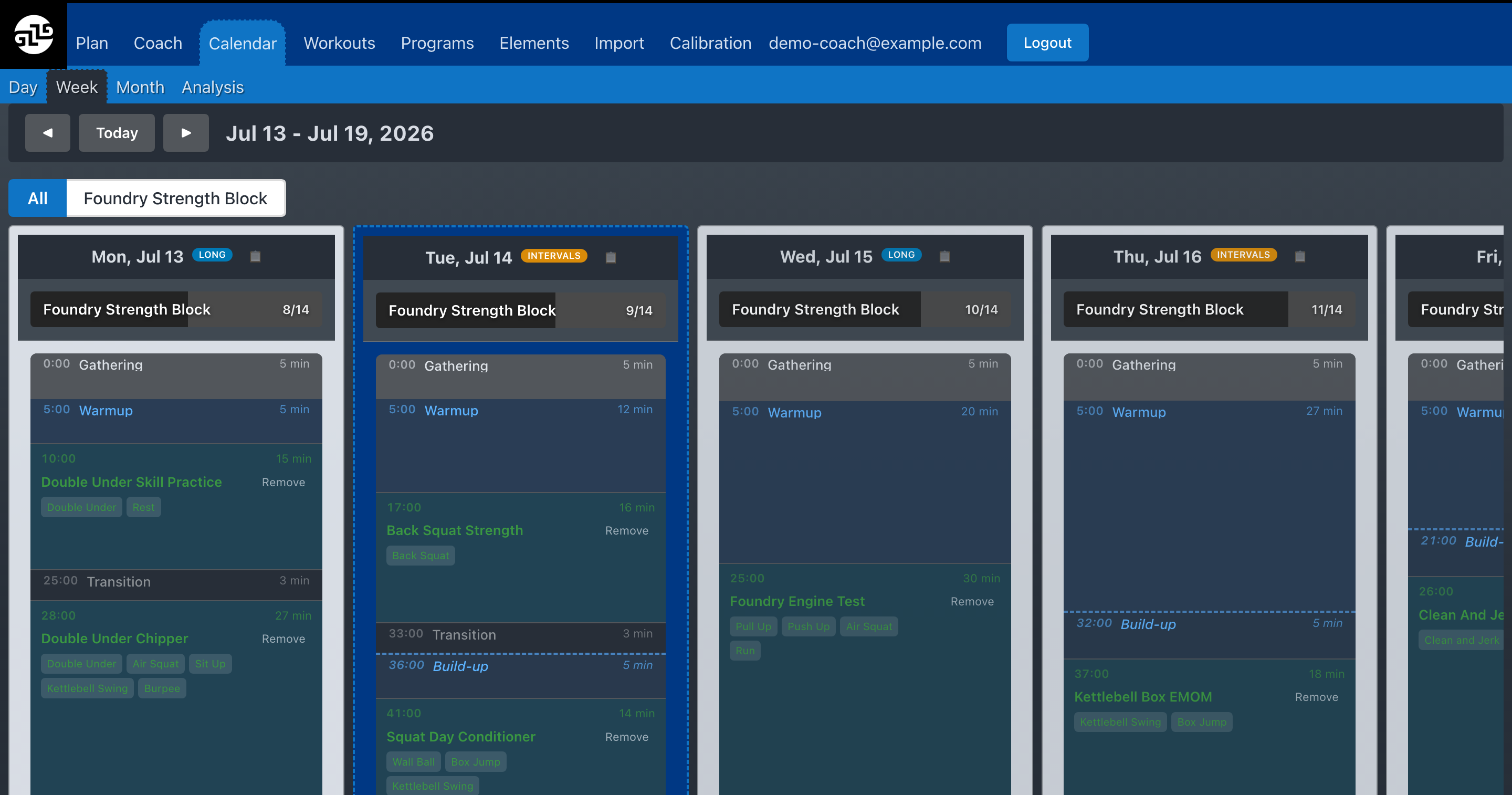
The job you're actually doing when you program is tracking what your members need. What the Tuesday/Thursday crowd still hasn't touched this month. Whose shoulder is still cranky. Which movement your daily lifers haven't rested enough to hit again safely. When you can't hold that in your head, the answer to "why are we doing this?" stops being about them and starts being about whatever you could think of the night before.
Limberjack holds the tracking for you so your decisions stay about the people on your floor. Every movement connects to muscle groups with activation percentages, and as you build workouts, each muscle group shows a bar and a fatigue level in words, so you can tell what's fresh and what's fatigued without relying on color:
You're not guessing anymore. You're seeing.
Warnings That Look Both Ways
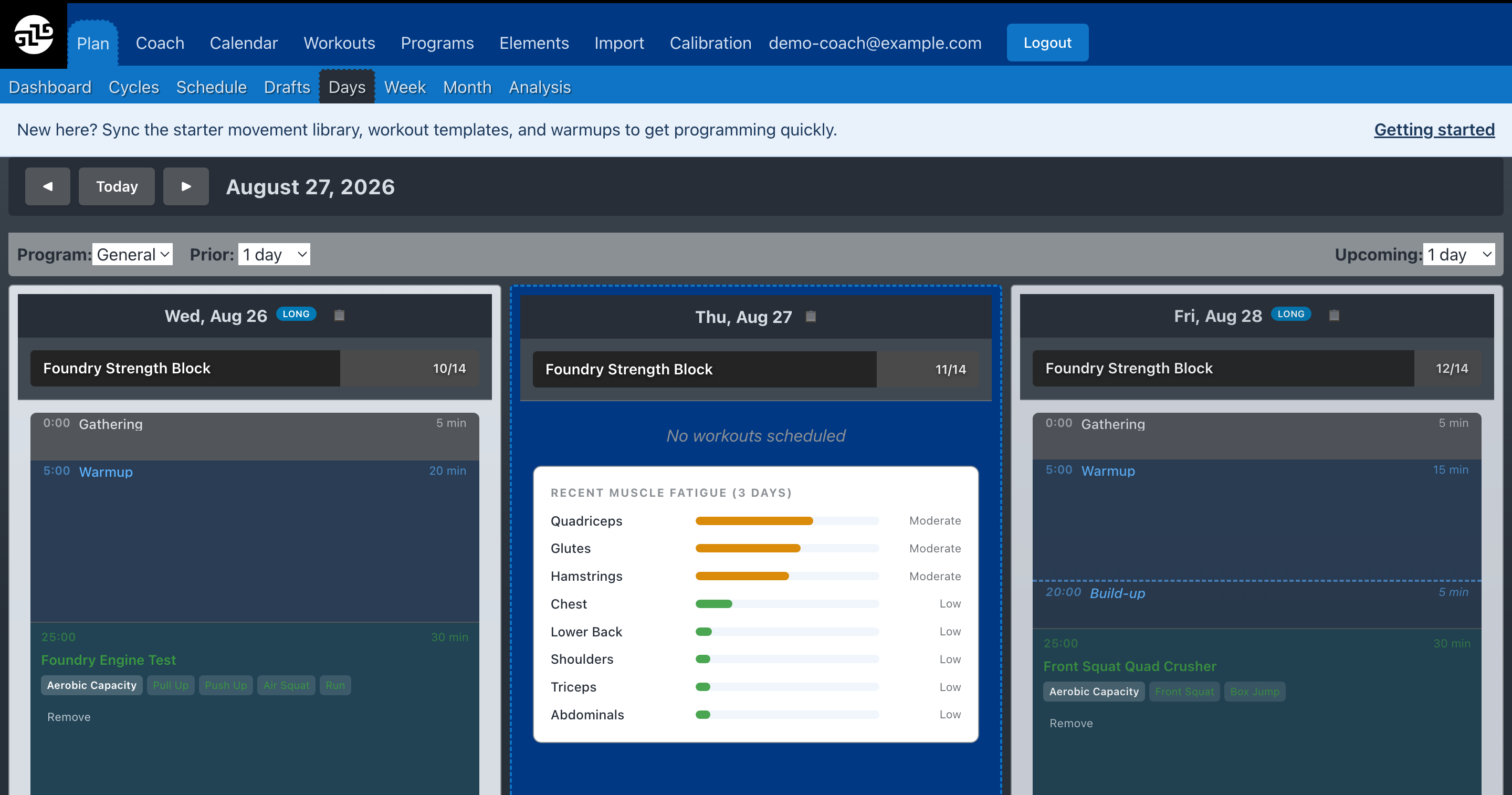
Most programming mistakes aren't about yesterday. You write Tuesday on Monday night, and the squats you already planned for Thursday are invisible to every tool you own. By the time you notice, your members have squatted three times in five days.
Limberjack's warnings look in both directions. Schedule front squats for Friday and Wednesday's air squats get flagged with the front squats coming in 2 days. Leave Thursday open between two heavy days and the day itself tells you what to do with it: which muscles to avoid and which are fresh.
Every warning carries a one-click fix. Suggest swap offers replacements in two groups: fresh-muscle alternatives that dodge the conflict, and similar-feel variants when the problem is boredom, not fatigue. Pick one and the workout updates, with shared workouts safely copied for that day only.
Element Groups: Catch the Repeats You Don't Notice
Front Squat on Monday. Back Squat on Wednesday. Overhead Squat on Friday. Technically different movements. Functionally the same posterior chain three days in a row, and exactly the kind of thing nobody catches until a member points it out.
Limberjack detects related movements and warns you when grouped elements appear too close together, even when the names look different. Create groups manually or let the system suggest them based on common naming patterns.
17 Muscle Groups, Precise Activations
Seventeen muscle groups organized into categories: Upper Push, Upper Pull, Core, Lower Anterior, Lower Posterior. Each element gets activation percentages: Back Squat might be 80% Quads, 60% Glutes, 40% Hamstrings.
Activations auto-populate from a reference database of 873 exercises. Fine-tune manually when needed.
Intensity Analysis
Stop Guessing Whether Today Was Too Much
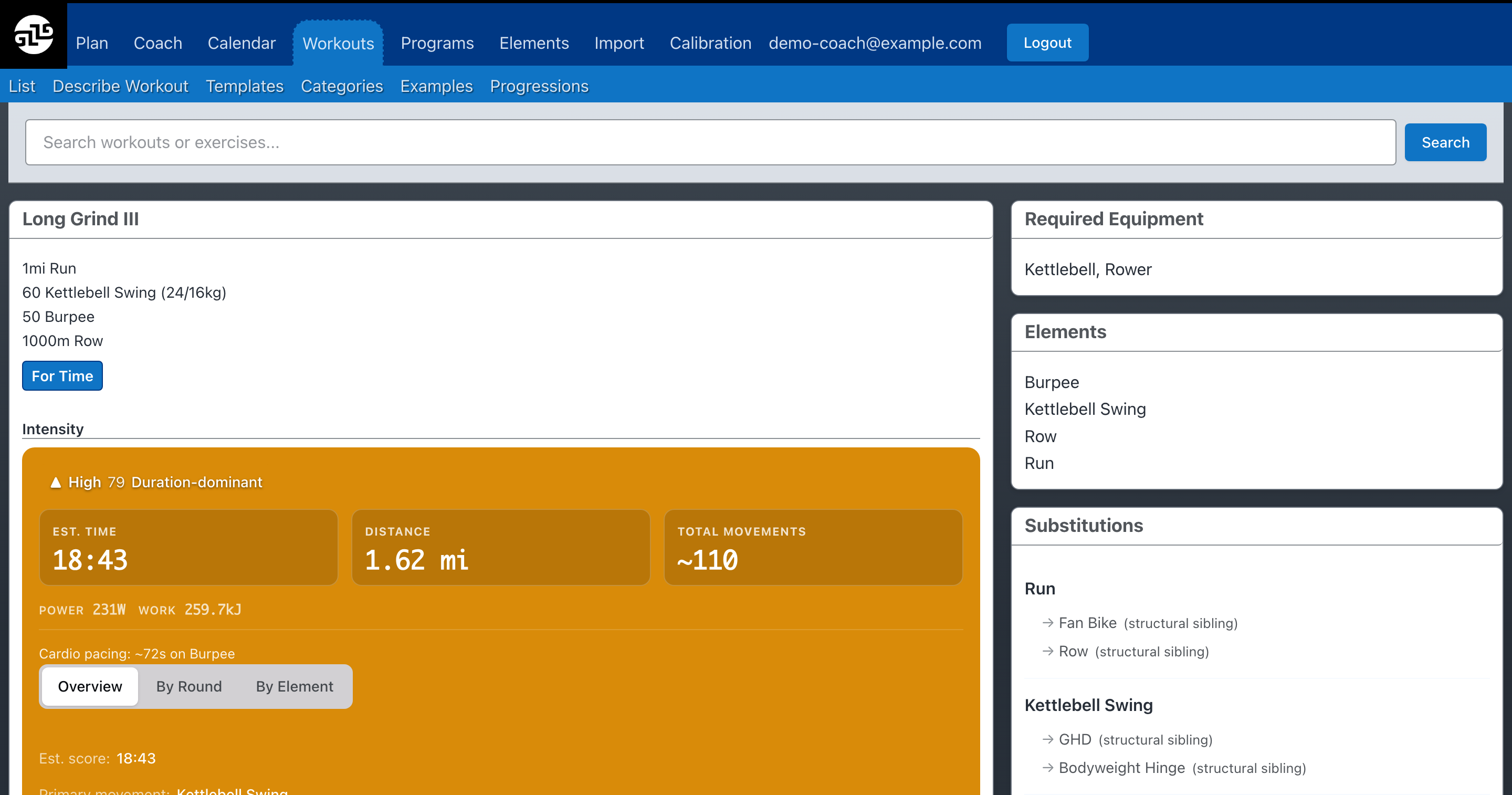
You know the feeling: you put today's workout on the board, and halfway through class you're wondering whether it's going to crush the 6am regulars. Then tomorrow comes and you have to guess whether to push harder or back off, with no anchor beyond how tired everyone looks.
Every workout gets a real-time intensity score based on power output calculations, so you have something concrete to compare against instead of hoping you got it right. The system accounts for:
- Movement profiles: Each element has time-per-rep, fatigue curves, and load sensitivity
- Prescribed conditions: Weight, distance, and percentage modify difficulty
- Workout format: AMRAPs, EMOMs, ladders, and intervals each affect intensity differently
- Fatigue accumulation: A bounded model that stays realistic at high rep counts
See intensity scores on the calendar, in the builder, and on workout pages. Compare what you planned against what you programmed.
A Calibration You Can See
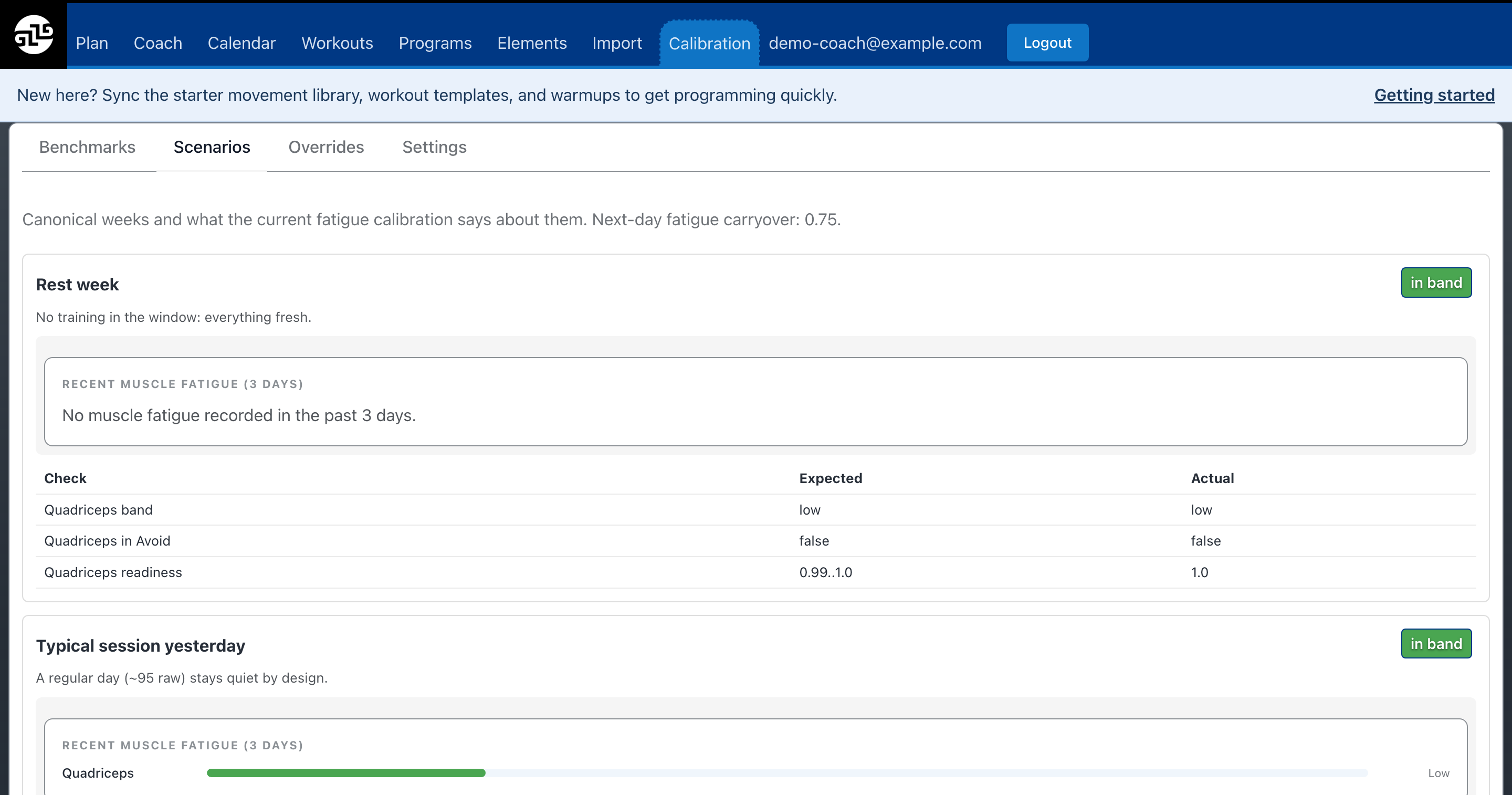
Every recovery tool makes a judgment call about how fast fatigue fades. Most hide it. Limberjack shows you the whole model on one page: canonical weeks like "hard session yesterday" and "three hard days back to back," each with the exact bands, warnings, and readiness the system produces, checked against what a coach would expect.
The philosophy is deliberate: hard days warn, regular days stay quiet. And if your gym recovers faster or slower than the default, one dial (next-day fatigue carryover) retunes every warning, guidance chip, and ranking at once, and this page shows you exactly what changed.
Condition Standards
Define your gym's expected values for weights, distances, and percentages. When a workout uses unexpected combinations (185 lb thrusters when your standard is 95/65), you'll see an alert in the preview.
Catch programming mistakes before athletes do.
Workout Generation
Skip the Blank-Page Stare
The worst hour of your programming week is the first one: sitting in front of an empty whiteboard at 9pm, knowing the week needs something, unable to remember what you last programmed, and afraid of doing the same thing you always do.
Select a format, pick a target intensity, and Limberjack generates a complete workout you can adjust from. It's not a replacement for your judgment. It's a starting point so you're never staring at a blank page the night before class, and unlike a generic generator it already knows what you ran last week. The generator uses:
- 60+ workout patterns spanning all energy systems and scoring types
- Historical quantity prediction: Rep counts based on what your gym actually programs
- Format-specific builders: AMRAP, EMOM, For Time, Chipper, Ladder, Tabata
- Recovery-aware element selection: Prioritizes movements that are ready
Nothing here is invented from nothing. Every draft is built from your library, your history, and your recovery picture, and it is yours to reshape. The generator hands you a well-structured first pass so your attention goes to the members who will do it, not the blank page.
Element Recommendations
When you need a movement, the recommendation engine scores every element in your library by:
- Recovery status: Recovered elements rank higher
- Programming frequency: Underused movements get priority
- Intensity match: Elements that fit your target difficulty
- Group conflicts: Penalizes movements with recent muscle overlap
One click adds a recommended element to your workout.
Weekly Planner
The Whole Week on One Page
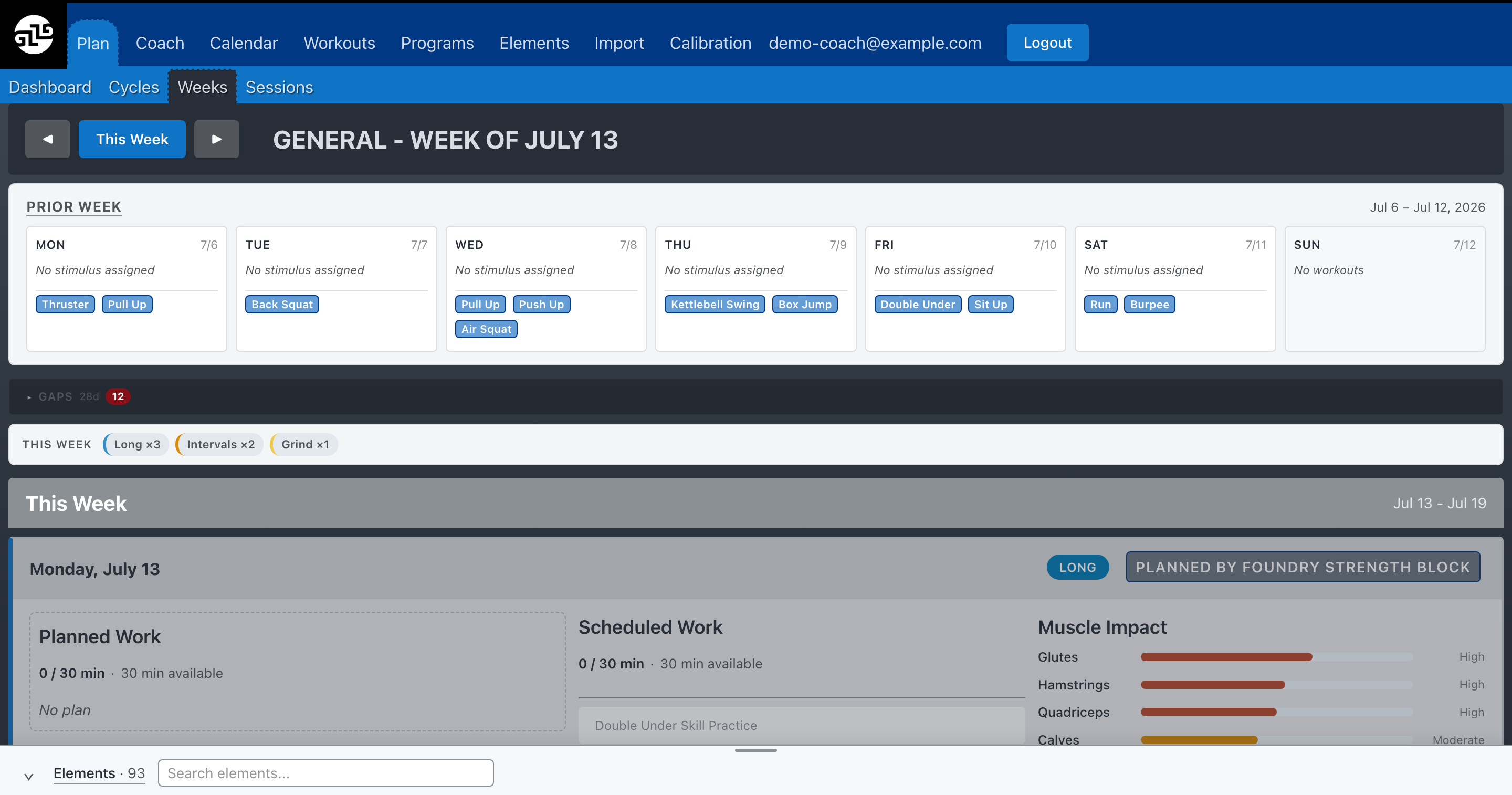
Programming a week in pieces means the balance lives in your head. You write Monday, then Wednesday, then Friday, and by Friday you've forgotten whether Monday's squats plus Wednesday's deadlifts are going to trash Saturday's class.
The weekly planner puts last week's actuals next to this week's plan. Each day gets a session template, or build custom sessions. Recovery status, planned stimulus, and energy system distribution for the whole week, in one view, while you're still making the decisions.
Fill an Open Day with the Right Workout
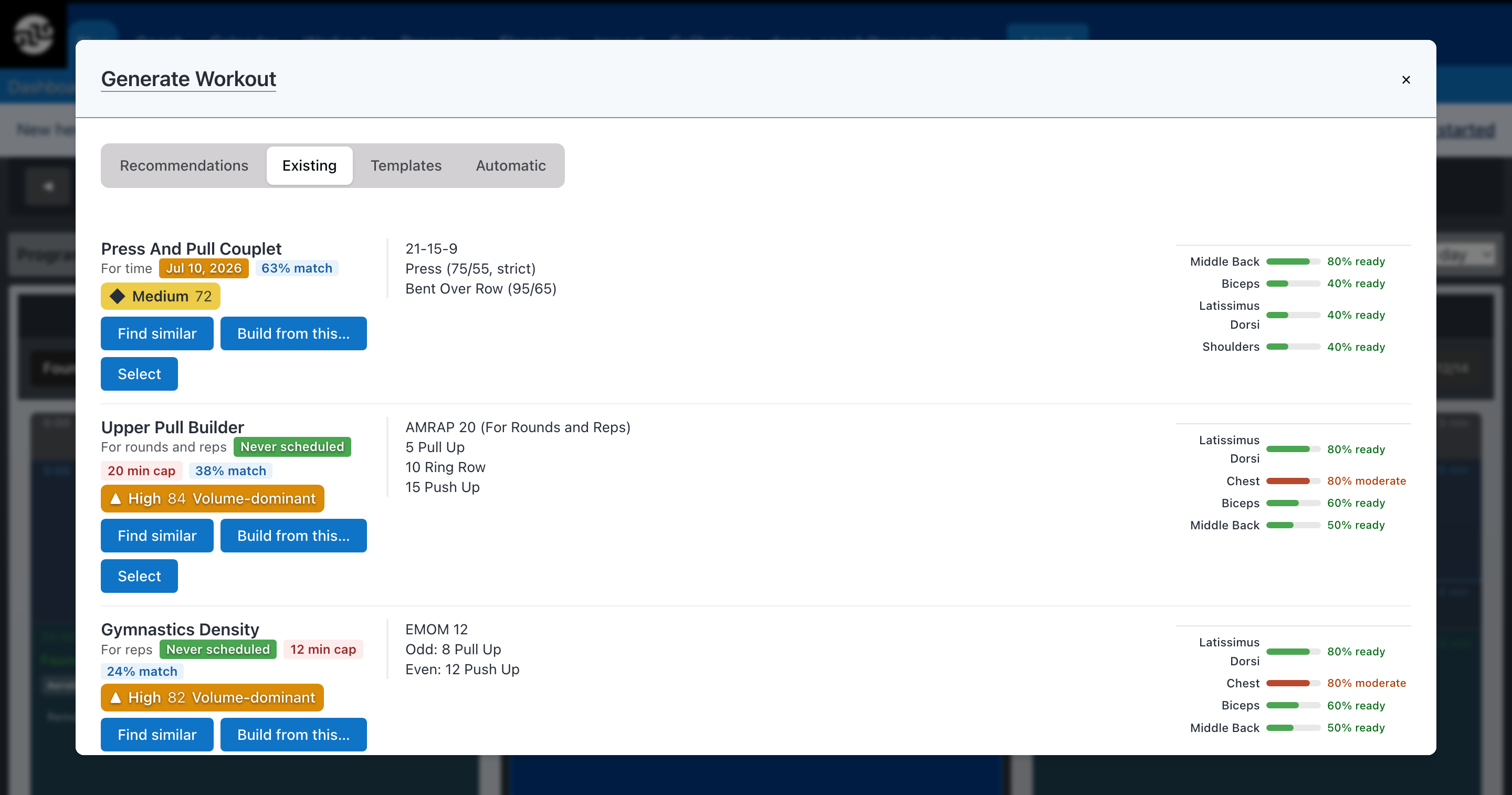
An empty Thursday between two heavy days is a specific problem: it needs work that avoids what's cooked, hits what's fresh, and isn't the same thing you ran last week. Scrolling your workout library hoping to remember the right one is not a system.
Open the schedule picker on any day and your library arrives already ranked for that day. Each candidate shows a fit score and the reasons behind it: which fresh muscles it targets, which loaded ones it avoids, whether it matches the day's plan, and how long since it last ran. Anything programmed in the last month is filtered out entirely, so the picker never suggests a repeat. There's a Find a better fit action on every scheduled workout too, for when a day is filled but wrong.
Energy System Budgets
Every workout draws from three energy systems: phosphagen (power), glycolytic (threshold), and oxidative (endurance).
The planner tracks your weekly budget across all three. See whether you've overloaded glycolytic work or neglected the aerobic base, before your athletes feel it.
Stimulus Planning
Plan intended stimulus types across your calendar. Color-coded badges show at a glance whether you're hitting the variety your athletes need.
Link stimulus plans to training cycles for focused programming blocks.
Workout Builder
Speaks Your Language
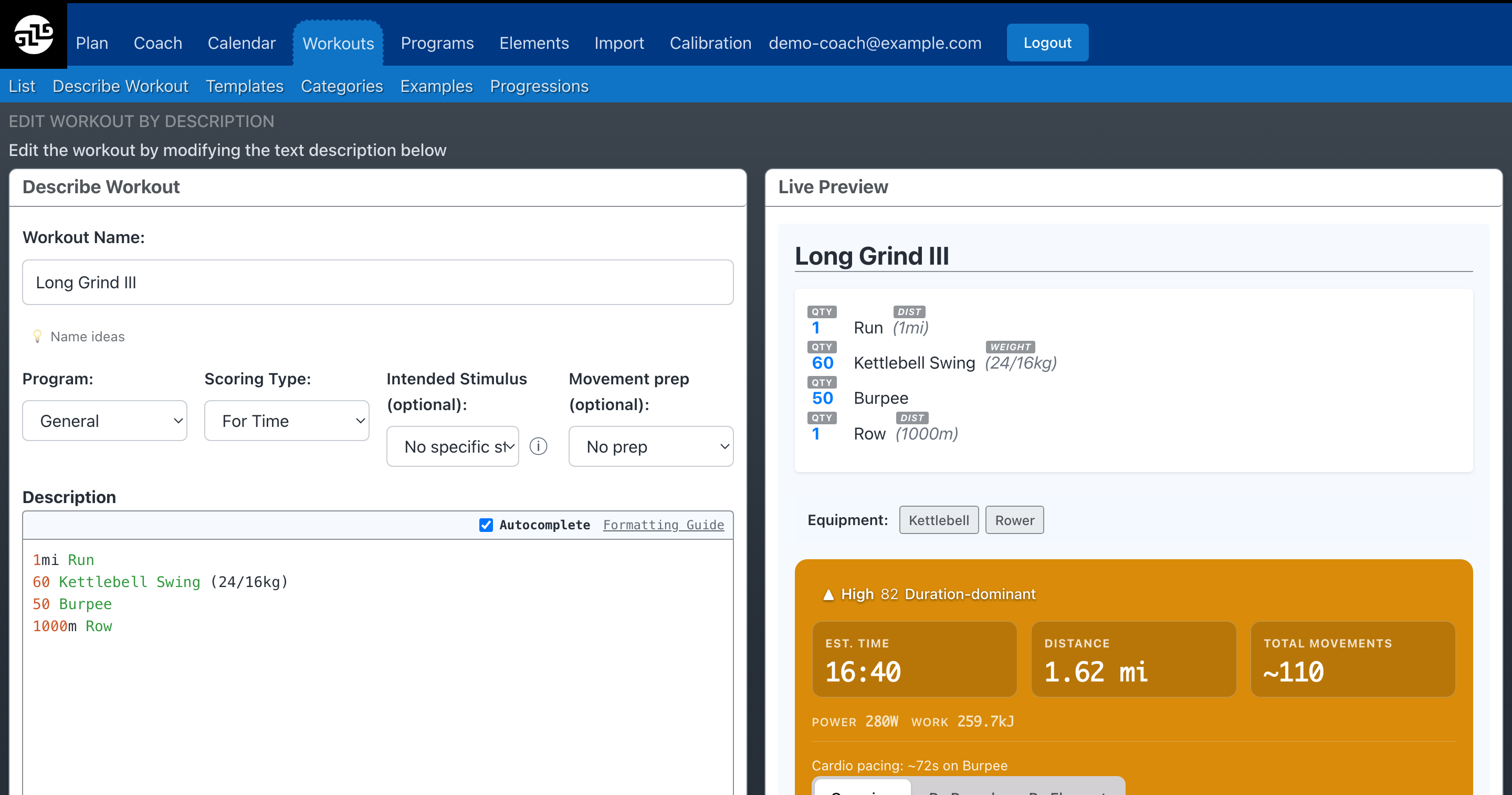
AMRAP. EMOM. For Time. For Load. Tabata. Ladders. Multi-score. Team workouts.
Type naturally, and Limberjack parses it correctly:
AMRAP 20
5 Pull Ups
10 Push Ups
15 Air Squats
EMOM 12
Min 1: 15 Cal Row
Min 2: 12 KB Swings (53/35 lb)
Min 3: 9 Burpees
For Time (135/95 lb):
21-15-9
Thrusters
Pull Ups
AMRAP 10
5cal Row (+5cal)
5 Pull Up (+5)
The parser handles complex structures (segment-level conditions, buy-in/cash-out, penalties, partner work, scaling options) and preserves them through edits. Per-round increments scale element values automatically: (+5cal), (+5lb), (+0:10) turn any AMRAP or EMOM into a progressive workout.
Real-Time Feedback
Every movement you add updates recovery and intensity views instantly. Notice you're stacking too much pressing work? Swap in a hinge movement. See intensity climbing too high? Reduce volume.
The feedback loop is immediate. Watch it happen live in the demo, no account needed.
All Workout Formats
Program any structure your gym uses:
- Standard: For Time, AMRAP, For Reps, For Load
- Intervals: EMOM, E2MOM, Tabata, custom work/rest
- Ladders: Ascending, descending, accumulating ("12 Days of Christmas")
- Multi-score: Independent scoring per segment
- Team/Partner: Divide work, synchronized, stations
- Penalties: Per-element conditional penalties
- Modifiers: Buy-in/buy-out, scaling options, segment conditions
Group workouts into categories you define (benchmarks, hero workouts, skill tests) so a standard is easy to find when it is time to retest it.
Import Your Existing Programming
Don't Rebuild a Year of History From Scratch
You've spent years building your programming. Hundreds of workouts. Thousands of decisions about what your members can handle. All of it trapped in spreadsheets, old WOD boards, and whichever gym software you were using three years ago.
Limberjack reads it in. The patterns you couldn't see across a year of workouts become obvious. Movements you've been quietly neglecting, days you always overload, cycles that actually worked: all visible in minutes instead of invisible forever. Import from:
- CSV spreadsheets: Your own format
- JSON exports: Push Press and similar platforms
- Excel files: Wodify and other gym software
Limberjack parses workout descriptions, detects formats, and maps movements to your element library. Months of programming become visible in minutes.
Element Matching That Remembers Your Answers
When imports encounter unfamiliar movement names, you resolve them once:
- Create new element: Add it to your library
- Create alias: Link "Thrusters" to your existing "Thruster"
- Skip: Ignore movements you don't want to track
Future imports automatically use your resolutions. You teach Limberjack your gym's vocabulary once, and it keeps applying what you taught it.
Handle Thousands of Workouts
Importing 5,000 workouts from Wodify? No problem.
Pagination, search, and bulk operations let you review large imports systematically.
Training Cycles
Focused Programming Blocks
Organize programming into training cycles, focused periods with specific goals:
- 6-week strength cycle emphasizing squats and deadlifts
- Competition prep peaking for the Open
- Skill cycle for gymnastics development
- Base building with balanced variety
Cycle Planner Integration
Plan entire cycles with the draft grid. Assign session templates to each day, set scoring types, generate workout names, and finalize when ready.
The planner respects your energy budgets and connects directly to the builder for detailed workout creation.
Programming Analysis
The Complete Picture
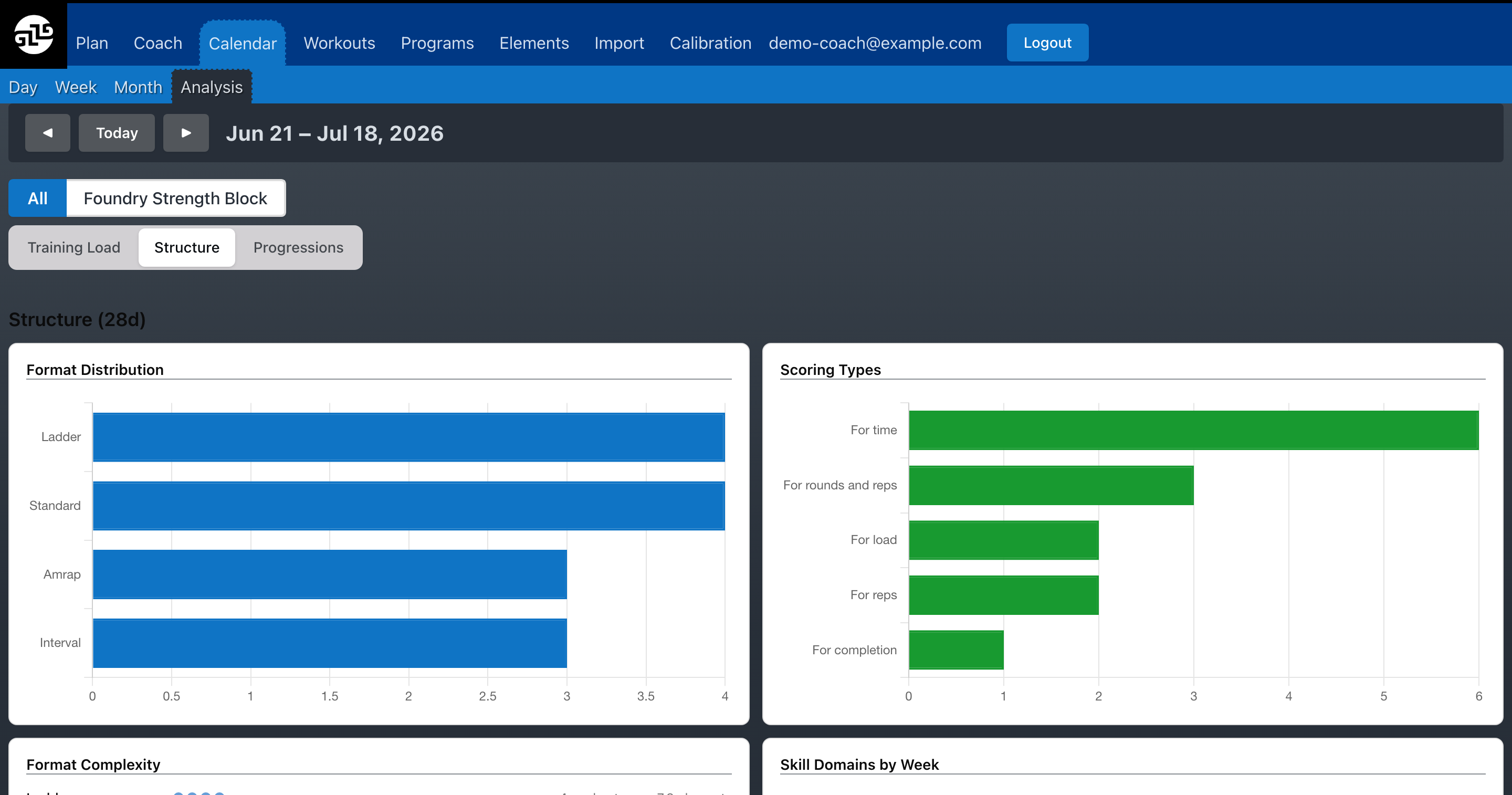
See what your programming actually did across weeks and months. The analysis page reads a window of occurrences and charts the patterns individual days hide:
- Movement-pattern and muscle distribution across the block
- Format and scoring-type distribution
- Intensity scores and predicted fatigue trending over time
- Stimulus variety and energy system allocation
- Time-domain spread, from the shortest piece to the longest
Audit the Programming You Already Run
Every workout in a month can look reasonable on its own while the month adds up badly: four hinge-heavy days in six, a quarter where nothing ran longer than twelve minutes, three heavy days back to back, the same benchmark twice in a month. A human cannot hold a hundred movement exposures in their head. The analysis page holds them for you.
Pick any window (this week, the last 28 days, a cycle, a season) and Limberjack checks it against nine constraints:
- Movement-pattern coverage: squat, hinge, push, pull, carry, and the rest, against what a balanced block owes
- Push-to-pull and anterior-to-posterior ratios
- Programming mix against the program's targets: energy systems, time domains, day intents, load levels
- Format variety, so the month is not all 10-minute AMRAPs
- High-intensity ceiling and recovery windows between hard days
- Repetition of the same workout too soon
- Heavy-load streaks
Each finding comes with a suggestion, and the report reads out what the numbers mean in plain sentences: which muscle carried more of the load than your library is built for, which movement family is running hot while another sits unused, whether long sessions are shrinking across the quarter, and which week was the one a deload would have prevented.
This works on programming you wrote and on programming you imported. If you run a purchased program, the numbers can be brutal once somebody adds them up: a workout whose three rounds add up to 105 deadlifts, a hundred pull-ups after weeks with none. Import it and the analysis page puts the load against what the last month prepared the room for, overall and for each muscle group. Schedule the week and each day carries its verdict in the builder, so you adapt the program to your room a week ahead instead of finding out on the day.
Calendar View
Every Day in Context
The month view puts each day's intensity, stimulus, and warnings side by side, so a heavy day next to a heavy day is visible before either one runs. Filter by program, jump to any week, and open a day to plan it with the recovery picture already on screen. In the builder, each day of the week carries a load verdict before you run it: Go, Hold, or Back off, with the reason.
Weather-Informed Programming
Limberjack shows weather forecasts for your gym's location. No more scrambling when you check the weather at 5am and realize today's outdoor WOD won't work.
Multi-Program Support
CrossFit, Hyrox, and Beyond
Run multiple training programs from one account. Each program gets its own:
- Weekly planner and energy budgets
- Session templates and workout patterns
- Recovery tracking and element library
Switch between programs or view them side by side on the calendar.
Slack Integration
Daily Workouts on Demand
The /limberjack slash command posts today's workout directly in Slack. Athletes and coaches get workout details without logging in.
Draft From Anywhere
Coming Soon: Your Gym's Context in Whatever Tool You Write In
A workout written from a generic template can't know that your members squatted Monday and Wednesday, that the Thursday crowd skews older, or that this cycle owes three more vertical-pulling exposures. A workout invented in a vacuum is exactly the kind of workout the balance math exists to catch.
We are opening a secure connection so the tools you already write in can work from your gym's actual data. Approve the access once, and a connected tool sees what you see: the weekly plan, muscle fatigue for every group, the balance report for any window, what has recovered, what is overdue, and what the recommendation engine ranks for the day. Ask for a draft from wherever you are and it lands in your drafts with an intensity forecast attached, for you to review before anything goes on the whiteboard.
A connected tool starts from your programming, not from nothing. It will never publish without you. Not available yet, and pricing for the connection has not been decided.
Element Library
Your Movement Vocabulary
Every movement your gym uses, organized and searchable. Each element connects to:
- Muscle activations: Percentage-based activation for each of 17 muscle groups
- Aliases: Recognize "Thrusters" and "Thruster" as the same thing
- Power profiles: Time-per-rep, fatigue curves, load sensitivity for intensity calculations
- Last programmed: When you last used this movement
- Recovery status: Current state for this element
Build your library once. Use it forever.
What's Coming
On the Roadmap
- Load-aware recovery: Factor prescribed weights and distances into recovery, on top of the rep counts already tracked
- Cohorts: Intensity forecasts for the whole room, from the fastest finisher to the last, not one average athlete
- Draft from anywhere: Connect the tools you already write in so they work from your gym's real programming (see above)
Built by coaches for coaches. Evolving based on what you need.
Simple Pricing
One Plan. No Per-Athlete Charges.
Your membership grows and your bill stays the same.
$79/month for everything on this page, or $869/year with one month free.